Painting sizes, media, and number
3.4 Sizes and media
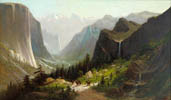 |
| Yosemite Valley, California, from Artist's Point [1] (attributed), 42 by 70 inches |
Although he frequently depicted grand wilderness spectacles such as Yosemite Valley, Mount Hood, and Mount Shasta, in only a half dozen known paintings did Schafer use a canvas exceeding the 30 by 50 inch size that was apparently the custom for Mechanics Hall exhibitions at the time. The largest paintings reported are 42 by 70 inches; there are apparently no wall-sized paintings such as those sometimes painted by Bierstadt, Keith, and Hill, each of whom produced canvases of 70 by 100 inches or larger. A majority of Schafer's horizontally-oriented studio paintings are on a canvas of 30 by 50 inches, while the vertically-oriented works are usually on a canvas of 30 by 20 inches. There are also many smaller paintings ranging down to around 6 x 10 inches in size that appear to be field sketches, and two miniature watercolors, 3 by 5 inches, have emerged.
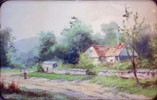 |
| [Farmer, farmhouse, and dirt road] |
By far the majority of Schafer's works are oil on canvas, though some of the small oils are done on canvas-covered artist's board (in addition, later conservators and restorers have laid some of the small canvases down on board). There are about twenty watercolors and gouaches, generally on some kind of artist's board. Several of these are dated, and the dates are very late in Schafer's career: 1898 and later, though some of the undated watercolors seem to be German, which would place them at the beginning of his career. An undated example, is at the left and a list of these paintings may be found in the index of watercolor and gouache paintings.
In addition to conventional media, Schafer painted a set of wall murals and a ceiling fresco for the Oak Grove Masonic Lodge in Alameda, California and, as mentioned in Schafer's background and training, scenery used in Oakland, San Francisco, and Los Angeles theatres.
3.5 On the number of paintings by Schafer
This inventory lists over 950 different titles, which have been found in sources ranging from auction lists of the 1880s to current dealer inventory. Of these, about 750 have been located and described; about 35 of those have attributions that can be questioned. The approximately 200 unlocated titles include many for which virtually no information beyond the title is known. Since there is little chance of matching those titles with catalogued paintings some of the unlocated paintings may already appear in the inventory. On the other hand, since one primary market for Schafer's paintings was in San Francisco, some--perhaps many--of the unlocated paintings from nineteenth-century lists may have been lost in the fires that followed the 1906 San Francisco earthquake.
Paintings by Schafer from previously unknown private collections have for the last decade been emerging at the rate of about ten to twenty per year and so far that rate shows no signs of slacking off. From the reports that accompany such paintings they seem to appear after an average of two or three generations of family ownership extending over 50 to 75 years. At that rate on can speculate that the total number of paintings extant by Schafer is probably in the range between 800 and 1,500.
3.6 Copies and reproductions of Schafer paintings
Schafer's great-grandson has reported that in his later years the artist was plagued by a "copycat". See the legend "A copycat and a sidearm" for more details. In addition, the proprieter of Galerie Mongeon in Seattle reported that he had in his inventory, in addition to a genuine Schafer painting, an example of a copy, but he provided no further information.
In recent years auction houses have been posting on the Internet high-resolution images of art works in upcoming sales. This practice has attracted vendors, mostly in China, to offer to prepare hand-painted copies of some of those works, even allowing the purchaser to choose the size. Copies of a dozen or so of Schafer's paintings, all of which are out of copyright, have been advertised for sale, primarily on eBay. Examples have not been examined to see if they are marked in any way to show that they are copies. Making copies of old paintings is an ancient Chinese tradition, as well as a modern high-volume business. The book Shanzai: Deconstruction in Chinese explores this topic in depth and it is summarized briefly in this article.
In addition, entrepreneurs using the same high-resolution images have employed high-resolution inkjet technology to make mechanical reproductions called "giclees" (from the French gicler, "to squirt") on various supports, most often canvas or paper. Several of Schafer's paintings are now offered in this form.