Signature inscriptions
(Note: More information about each painting that bears an inscription illustrated here can be obtained by clicking on the image of the inscription and then on the title of the painting.) 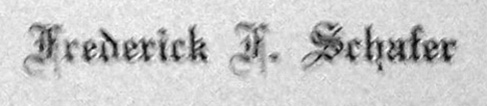
![[Typical signature]](../inlines/p/img0719.jpg)
Typical signature compared with printed calling card
Schafer's signature is usually inscribed using short, straight or slightly curved strokes reminiscent of 19th century German blackletter printing, similar to the font he used on his calling card. The initials are in capitals, the remainder of the surname in small letters. The downstroke that completes the "h" typically descends below the line and the vertical line of the small "f" in the middle of the surname is notable for its length and emphasis, usually extending both above and below the other letters. In an example below in which the artist spelled out his first name, both examples of "f" are large and capitalized. A high-resolution image of one typical signature reveals the order of some of the individual brushtrokes. The catalog refers to this style of printing as the artist's "block-letter hand".
![[Signature with monogram]](../inlines/p/imgd540.jpg)
Monogrammed signature
In about one out of twenty signatures, the initial letters F and S are conjoined into a monogram, followed by the remaining letters of the last name. An example appears at the left, one of the few signature inscriptions that includes a date. Dates in the 1800's are usually written with just the last two digits; starting in 1900 Schafer began using 4-digit dates exclusively. The examples of dated paintings with monograms span a wide range of years, so it does not seem possible to use the presence of a monogram to help date a painting.
![[signature with umlaut]](../inlines/p/imgd541.jpg)
Signatures with accents
About one in ten signatures is accented with an umlaut over the "a" in "Schafer" as in the example at the right. When it appears, the umlaut consists of two thin lines slanted toward each other, nearly touching at the center; it has been misread as a circumflex. Coran and Nelson-Rees suggest that these paintings may be early works, perhaps done before the artist emigrated to the United States.1 Two of these umlauted signatures appear on studio still-lifes that may have been done as training exercises, one appears on an unmistakably Alpine mountain scene, and one such painting has a verso title in the German language, so this conjecture has some promise, although one report of a possible umlaut is on a painting said to be dated 1891. With that unverified exception, the California paintings that are signed with an "ä" may have been among Schafer's earliest American paintings, done before he settled on an Americanized signature.
![[signature with acute accent]](../inlines/p/imgd010.jpg)
![[signature with grave accent]](../inlines/p/imgd005.jpg)
Curiously, some signatures appear with an acute or grave accent over the "a", rather than an umlaut.
![[signature with S.F. following]](../inlines/p/imgd001.jpg)
Signature addenda
In addition to the infrequent dates mentioned above, occasionally the letters "S.F." (and in one case the words "San Francisco") follow the signature, as at the right. Two of the paintings bearing the "S.F." inscription are dated 1881, and a likely speculation is that all of the paintings with "S.F." were executed during the years 1880-1886 when the artist had a studio in San Francisco.
![[signature with full first name]](../inlines/p/imgd002.jpg)
![[signature omitting first name]](../inlines/p/imgd1585.jpg) Frederick Schafer's first name is usually represented only with the initial "F", but in a few paintings it is spelled out in full or abbreviated, for example "Fred'k". As in the example at the left, the signature is frequently underlined. Note also in this example the previously mentioned capital "F" in the middle of the last name. On the right is the one example that has emerged of an authentic painting bearing a signature that completely omits the first name.
Frederick Schafer's first name is usually represented only with the initial "F", but in a few paintings it is spelled out in full or abbreviated, for example "Fred'k". As in the example at the left, the signature is frequently underlined. Note also in this example the previously mentioned capital "F" in the middle of the last name. On the right is the one example that has emerged of an authentic painting bearing a signature that completely omits the first name.
Good examples of Schafer's signatures, except for the umlauted "ä", are available in two widely available signature dictionaries.2
![[signature with ae spelling]](../inlines/p/img0906.jpg)
As already mentioned in the section on Schafer's background and training, some sources report that the artist also signed paintings with a wide range of alternative spellings such as "Schaeffer". This survey has found several hundred examples of legible signatures; all but one of these is spelled with a single "f"; the one with "ff", curiously, omits the "c". Two paintings (including the one that omits the "c") are signed with the umlauted "ä" replaced with the anglicized form "ae". One signature is spelled "SHAFER" in all capitals; the attribution of that painting is questionable, based both on the style of the painting and the style of the signature. Until more verified examples are found of authenticable paintings with different spellings, claims of signatures with variations other than in the representation of the German "ä" should be viewed with some skepticism. As suggested before, other spellings are found in nineteenth century newspaper articles and advertisements, but they most likely are examples of sloppy editing, and those appearances may have added support to the claims about differently-spelled signatures.
Thirteen examples have been found of attributed but unsigned paintings; two of those have Schafer's name inscribed on the back in a script hand; two more are said to have his name verso in an unspecified hand; a fifth is probably misattributed. The small number of unsigned paintings does not necessarily mean that very few paintings were unsigned; it may only indicate that unsigned paintings have not yet been identified and attributed.
Other signature forms
![[signature using rounded strokes]](../inlines/p/img0884.jpg)
![[signature using rounded strokes]](../inlines/p/img0882.jpg)
Several paintings that, on the basis of style, composition, palette, and structure, seem to be by Frederick Schafer bear signatures that are in a hand that is quite different from the artist's block-letter hand. This different hand also is written using separate block letters but with more rounded strokes and different letter shapes. This form of signature is found most often in small field sketches but there are also a few studio-size paintings. At least three potential explanations come to mind:
- The field sketches, not being intended for sale, were originally unsigned. Upon a later decision to sell them, someone else, perhaps Schafer's son, added the inscription.
- There is a family legend that in his later years Schafer was annoyed by a "copycat" who was imitating his painting style and forging his signature.
- To make ends meet, Schafer advertised painting classes, and in at least one such advertisement included the phrase "amateurs' work finished".
![[signature with monogrammed initials]](../inlines/p/img1491.jpg)
A few paintings that have been attributed to Schafer are inscribed simply with the initials "FS", but except for three paintings that are signed with monogrammed initials that closely resemble the monograms of the artist's signatures with a full surname (see example on the right), none of their attributions is very compelling, so these initials likely belong to other landscape artists. Some examples can be found on the page Signatures with initials only. Works by other artists who share the name "Schafer" sometimes lead to attribution questions, but those paintings are usually distinguishable from paintings by Frederick Ferdinand Schafer by their rather different overall style as well as obvious differences in the form of the signature. Several examples are discussed in the section Other artists with similar names or signatures.
1. Coran, James L. and Walter A. Nelson-Rees, If Pictures Could Talk, page 50.
2. The several examples in the 1988 edition of Falk, Peter Hastings, Dictionary of Signatures…, page 371, are representative, but that source does not include any example of the monogram or the umlaut. Castagno, John, American Artists: Signatures and Monograms, 1800–1989, on page 606, exhibits an example of the monogram, but in a signature that is otherwise not at all typical.