Iconography in Schafer's paintings
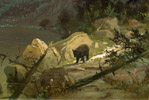 |
| Bear Lake in the Wasatch Mountains, Utah [2], detail |
As in the painting on the left, in mountain, forest, and river landscapes, foreground deadwood in the form of a standing or leaning dead tree, a fallen tree or log, or a river snag appears so frequently that it is almost a Schafer trademark. Although some level of clutter is not surprising in a wilderness scene, the log, dead tree, or snag is too often in a prominent position to be accidental. Some observers have suggested that deadwood in paintings may be a memento mori, a wilderness analogue of the ruins that decorate many European landscape paintings as a symbolic reminder of human mortality.1 Schafer's training may have included such a concept (and indeed some of his marine scenes include a fractured schooner mast lying on the shore), but a simpler explanation may be that the deadwood is a "memento Americano." One of the notable differences between the forests of Europe and those of nineteenth-century America is that the European forests had been picked clean over the centuries by villagers collecting firewood. The virginal, cluttered state of the American forests with their underbrush and rotting, fallen trees was a difference that European-trained landscape painters immediately noticed.2 Thus Schafer might well have depicted deadwood with the specific intention of identifying the painting as an American scene.
As mentioned earlier, staffage, in the form of small midground figures, usually of Indians but occasionally of trappers, hunters, prospectors, or even bear or deer, often appear as part of the natural landscape, providing an iconic, rather than explicit, genre touch in Schafer paintings. One evidence for this interpretation is that as often as not, human figures are facing into the landscape, avoiding confrontation with the viewer of the painting. Rather than representing an intrusion of civilization into nature, Schafer's human figures are as much a part of nature as the animals, and they go about their business as if unaware of being observed in their natural environment. Their function is probably more to provide a measure of the awesome scale of the landscape than to denote humanity.
Other popular icons of wilderness painters, such as representations of civilization, development, and progress in the form of sawn stumps, neat farms, chopped wood, and the railroad, do not regularly appear in Schafer's work, and it seems unlikely that in the works in which they do appear they take on the special significance they sometimes did, say, for the Hudson River painters.3
1. This theme is developed in the section entitled "Remedies for three major defects" in Callow, James T., Kindred Spirits, pages 129–135. Harrison, Alfred C. Jr., "John Ross Key, the California paintings" picks up the same theme, in Art of California 2, 2 (April/May, 1989), page 25.
2. At least two European-trained nineteenth century artists mention the cluttered American forest:
"In the American forest we find trees in every stage of vegetable life and decay—the slender sapling rises in the shadow of the lofty tree, and the giant in his prime stands by the hoary patriarch of the wood—on the ground lie prostrate decaying ranks that once waved their verdant heads in the sun and wind." Cole, Thomas, "Essay on American Scenery", pages 9–10. Longer excerpt.
"How different was the scene before me from anything I had been looking at for many years. The forest was a mass of decaying logs and tangled brush wood, no peasants to pick up every vestige of fallen sticks…nothing but the primitive woods with their solemn silence." Thomas Worthington Whittridge, in Baur, John I. H., editor, "The Autobiography of Worthington Whittredge 1820–1910", page 42. Longer excerpt.
3. Novak, Barbara, Nature and Culture, chapter VIII.