Similarities, affinities, and influences
Schafer's painting shows several affinities and similarities with the work of other artists but there is not enough information available to establish whether direct influences are involved. The potential sources of influence are from the nineteenth-century world of American art, from the local San Francisco circle of artists, from Schafer's (presumed) German training, and from developments in landscape photography.
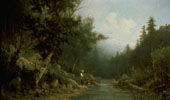 | 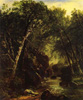 |
| [Fishing on the Sacramento River], by Frederick Ferdinand Schafer | Trout Fisherman, 1852, by John Frederick Kensett |
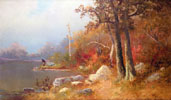 | 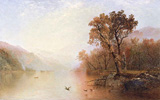 |
| [Autumn in the Adirondacks 1], by Frederick Ferdinand Schafer | Lake George, ca 1860, by John Frederick Kensett |
Much of Schafer's work resembles that of the Hudson River school. For example, Schafer's [Fishing on the Sacramento River], at the left, bears considerable resemblance in mood, composition, coloring, and detail to John Frederick Kensett's Trout Fisherman. Similarly, Schafer's [Autumn in the Adirondacks 1], at the right, bears a striking family resemblance to Kensett's Lake George. Since Schafer's arrival in the eastern United States in 1876 would have coincided with the peak of activity of the Hudson River school it is likely that he had some direct exposure to it.1
Some writers have characterized work by nineteenth-century western United States landscape artists such as Schafer as being of a "Rocky Mountain school" or "San Francisco school."2 Whether or not these school characterizations provide insight, there were several landscape artists who worked in San Francisco in the 1870's and 1880's whose work is in a common style: romantic realist in character, with a naturalist's preference for form rather than line, but with no other characteristics of the Impressionism that was emerging in France at the time. These artists, in addition to Schafer, included Julian Walbridge Rix, Raymond Dabb Yelland, Henry Raschen, Joseph Dwight Strong, William Keith, Thomas Hill, William Hahn, Carl von Perbandt, Juan Buckingham Wandesford, Norton Bush, Edwin Deakin, Charles Dormon Robinson, Thaddeus Welch, Henry Frederick Butman, and Ransom Gillet Holdredge. Many of these artists originally trained in Europe or went there to study. Hahn studied in Dresden; Hahn, Keith, and von Perbandt in Düsseldorf; Raschen, Strong, and Welch in Munich; Holdredge probably studied in Germany and presumably Schafer had at least some training in Germany (more on Schafer's training follows); the conservatism of the German academy may help explain their adherence to traditional modes of landscape painting. One thing that they did not bring back from the German academy was any tendency to fairy-tale fantasy as sometimes found in the German Romantic style.3
Although no specific evidence indicates that Schafer exchanged ideas with those other San Francisco artists, he certainly had many opportunities to see their work and they his. As mentioned in the discussion of Travels of the artist, from 1880 to 1886 he maintained winter studios in the artist's quarter of downtown San Francisco. He exhibited his paintings in joint shows at the San Francisco Mechanics' Institute Fairs in 1879, 1880, 1883, and 1884 and the San Francisco Art Association in 1880. He was a member of the San Francisco Art Association from at least 1880 to 1895. He sold his paintings in joint auctions in 1881, 1882, 1883, and 1884, and newspaper columnists of the time covered his work and theirs in the same columns. It seems safe to assume that Schafer was in many ways involved with the San Francisco circle of artists.4
Of the San Francisco artists, the one most easily mistaken for Schafer is probably Holdredge; their styles are sometimes virtually indistinguishable, in choice of subject and vantage point as well as brushwork and finish. Other contemporaries of Schafer with quite similar styles include Wandesford and Rix. The latter used similar brushwork but his work often has a tinted atmosphere and feeling of quiet more in the direction of the Luminist style. Yelland also used similar brushwork, but produced a very different, fussier appearance, while von Perbandt's paintings are characterized by much more texture. Schafer's foregrounds resemble those of 1880's paintings by Keith, while the middle distances of a typical Schafer landscape sometimes look as though they might have been painted by Hill.
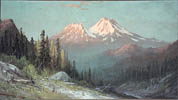 |
| [Mount Shasta 2] (attributed), by Frederick F. Schafer, signed "ABierstadt" |
A curious confirmation of the general similarity of Schafer's style to that of some of his better-known contemporaries is that paintings almost certainly by Schafer have been discovered bearing signatures of Albert Bierstadt, Thomas Moran, and Thomas Hill, each of which names usually bring higher prices than Schafer's. For example, the signature "ABierstadt" on [Mount Shasta 2] (attributed), at the right, is belied by, among other things, the misproportioned mountaintop; that unusual shape is a unique feature of many of Schafer's studio paintings of Mount Shasta, as is evident in the index of Mount Shasta and Shastina. Several additional examples of Schafer paintings bearing signatures of other artists may be found in the index of paintings probably attributable to Schafer.
As discussed in detail in Schafer's training, the only specifics that have so far been found concerning Schafer's training are what appear to be self-reported references to Düsseldorf in newspaper sale notices and auction advertisements. However, his use of classical landscape composition rules, saturated colors, and a palette of harmonizing shades of green and brown all suggest German training. His composition techniques of building up a landscape as a succession of planes parallel to the surface of the painting and ensuring that the scene contains framing elements are characteristics of the Düsseldorf school. And upon close comparison, Schafer's compositions are remarkably similar to those of Johann Wilhelm Schirmer (1807–1863), a leading landscape teacher at Düsseldorf, and of Caspar Johann Nepomuk Scheuren (1810–1887), one of Schirmer's students.5
Schirmer's Das Wetterhorn, Alpenlandschaft (1837), and Sumpflandschaft both use the same triangle-based composition, dark foreground, and rough finish that characterize most of Schafer's mountain landscapes, and the last-named painting depicts a river flowing from the center out to the front edge of the painting, a composition technique frequently used by Schafer. Schirmer's Abendlandschaft mit Blick auf das Heidelberger Schloss (1839), with its foreground rocks, middle range trees, and distant valley looks like a model for several of Schafer's valley landscapes. Schirmer's Waldrand (c. 1851) depicts a stroller walking along a path into the woods, using a composition for that subject repeated by Schafer in a dozen or more different paintings. Finally, Schirmer's Der Mittag depicts standing dead, gnarled trees in a way found in several Schafer compositions.
The similarity between Schafer's work and that of Schirmer's student Scheuren is even more striking. In Scheuren's painting Waldlandschaft, as in Schafer's [Landscape with trees and deer], the canvas is filled with the woodland and the central part is lit by a shaft of sunlight coming through an unseen forest opening. Scheuren's painting Rheinlandschaft (1847) in style and composition closely resembles Schafer's After a storm in the White Mountains, right down to the intensity of the activity of the fisherman. Finally, Scheuren's Die Drockenfels (c. 1851) in composition appears exactly like Schafer's several seascapes.6
Other similarities in style with Düsseldorf students are similarly striking. The paintings Wasserfall im unteren Teil von Telemark (1852) by Herman August Cappelen and Sonnen Untergang im Winterwald an einem Gehöft (1863) by Alexander Michelin both use tiny figures in a large scene in the same scale-emphasizing way as do many of Schafer's paintings.7 These many specific similarities may be coincidental, rather than indicative of direct influence, but there are enough of them to suggest that the Düsseldorf approach somehow made its way into Schafer's work.
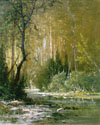 |
| [California coastal stream] |
At the same time, there are some significant divergences between Schafer's work and that of the Düsseldorf painters. The most obvious is that the Düsseldorf style encouraged a high degree of finish of brushwork. (The Düsseldorf-trained Albert Bierstadt's large canvases provide a prime example of highly finished brushwork.) Schafer's brushwork is much more casual, resembling more the Barbizon approach to painting, with loose brushwork and emphasis on the effect rather than on photo-realism. Similarly, his Corot-like palette, especially in his frequent use of baby blues and silver-grays in sky and water, suggests an influence from the Barbizon painters. In addition, there are a number of forest compositions done entirely in Barbizon style, such as the one on the right. It is not clear whether these influences from other schools were acquired in Europe before emigration to the United States, or were developed by rubbing shoulders with other San Francisco painters who were trained in Europe.
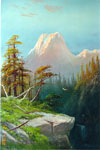 |
| [Lassen peak? 1] |
Influence on Schafer's work by the then rapidly-developing art of landscape photography appears in at least four different ways. First, his reliance on loosely-brushed form rather than on carefully-drawn line is probably the result of the general movement of late nineteenth-century artists to search for directions that did not directly compete with the camera. Second, his dramatic use of color to set the tone and mood was probably intended to help distinguish his work from that of the nature photographers, who were at the time restricted to monochrome reproduction. Third, his frequent use of prominent foreground objects (as in the example on the left) appears to be more than traditional repoussoir to produce a feeling of depth—it may be an attempt to create a three-dimensional effect with which the public had grown to be fascinated. The landscape photographers often placed prominent objects such as a rock, bush, or small tree at the very front edge of a scene, where they would appear nearly to fall into the viewer's lap when viewed stereoscopically.8
Finally, one might expect that Schafer would have taken advantage of the many available landscape photographs to supplement sketches made in the field. The landscape photographers Carleton E. Watkins, Eadweard Muybridge, and Charles Weed were all working in San Francisco at about the same time as Schafer, they photographed many of the same grand vistas that Schafer painted, and their work was widely exhibited, so they must have been known to Schafer. On the other hand, even though the available copies of those photographs show views from the same or almost the same vantage points (for example, of Donner Lake, Lake Tahoe, Castle Rock, Yosemite Valley, and El Capitan and Union Point in Yosemite,9 there is very little evidence of direct copying of any subject to which Schafer had access. On the other hand, as mentioned in the discussion of Travels of the artist, Schafer's paintings of Mount of the Holy Cross, in Colorado, do closely resemble the well-known 1873 photograph by William H. Jackson and probably was copied from that photograph, or from a chromolithograph by Thomas Moran that was apparently in turn based on that photograph.10
As to other artists being influenced by Schafer, there is no extant evidence. Perhaps there was some mutual influence between Keith, whose early pictures were carefully drawn, but who moved to a less finished style in later years, and Schafer, with his emphasis of form over line. (Ferdinand Perret attributes a comment to Keith that suggests that Keith was quite familiar with and enthusiastic about Schafer's work.11) On the other hand, Keith's shift can equally well be explained by his own visits to Düsseldorf or as an abandonment to the camera of the goal of achieving camera-perfect detail.12
1. Howat, John K., American Paradise, provides a good description of the Hudson River school. The two Kensett paintings are reproduced on pages 83 and 85 of Novak, Barbara, Nineteenth Century American Painting, a catalog of the Thyssen–Bornemisza collection.
2. The "Rocky Mountain School" characterization is the primary theme of the book by Trenton, Patricia and Peter H. Hassrick, The Rocky Mountains. The encylopedia Samuels, Peggy and Harold, The Illustrated Biographical Encyclopedia of Artists of the American West uses the "San Francisco School" characterization in its brief sketches of several San Francisco painters.
3. The Samuels & Samuels encylopedia cited in note 2 provides this information on the several artists' training. The German Romantic style is discussed extensively in two books: Finke, Ulrich, German Painting, and Vaughan, William, German Romantic Painting.
4. The titles of Schafer paintings exhibited at the Mechanics' Institute Industrial Exhibitions between 1879 and 1884 can be found in the list of Exhibitions. Schafer is listed as a member in the catalogs of the Exhibitions of the San Francisco Art Association in 1880 (15th), 1884 (Spring), 1885 (Fall), 1886 (Spring), 1889 (Spring), 1891 (May), 1893 (Spring), 1894 (Spring), 1895 (May/Spring). The list of Primary painting sales includes several joint auctions. Two examples of newspaper articles in the San Francisco Chronicle that include Schafer in the San Francisco art scene are "The Mechanics' Fair" and "What is Art?".
5. This use of color is evident, for example, in plates I–XXIV (pp. 217–240) of the exhibition catalog Kunstmuseum Düsseldorf, Die Düsseldorfer Malerschule (1979). In the exhibition catalog by Hoopes, Donelson F. and Wend von Kalnein, The Düsseldorf Academy and the Americans, pages 19–39, is an essay of the same title which explores this point. Baigell, Matthew, Albert Bierstadt on page 9 mentions abrupt tonal contrasts, hidden sources of light, tortured trees, agitated skies, and craggy landscape features as elements of Düsseldorf painting; all of those elements are also common in works by Schafer.
6. Reproductions of the paintings by Schirmer and Scheuren may be found in two exhibition catalogs and a book, all carrying the same title, Kunstmuseum Düsseldorf, Die Düsseldorfer Malerschule (1967), Kunstmuseum Düsseldorf, Die Düsseldorfer Malerschule (1979), and Hütt, Wolfgang, Die Düsseldorfer Malerschule, 1819–1869.
- Schirmer:
- Alpenlandschaft: 1967, figure 18, also in Hütt, plate 91
- Das Wettterhorn: 1967, figure 11; 1979, figure 230
- Sumpflandschaft: 1967, figure 31
- Abendlandschaft mit Blick auf das Heidelberger Schloss: 1979, fig. 231
- Waldrand: 1979, figure 234
- Der Mittag: 1979, figure 237
- Scheuren:
- Waldlandschaft: 1967, figure 23
- Rheinlandschaft: 1979, figure 222
- Die Drockenfels: 1979, figure 223
7. The paintings by Cappelen and Michelin are reproduced in Hütt, Wolfgang, Die Düsseldorfer Malerschule, 1819–1869 as figures 114 and 113, respectively.
8. This observation is from Cock, Elizabeth M., The Influence of Photography on American Landscape Painting, 1839–1880.
9. Reproductions of these photographs can be found in Naef, Weston J., Era of Exploration: The Rise of Landscape Photography in the American West, 1860–1885.
10. The speculation that Schafer (as well as Moran) may have worked from the Jackson photograph is due to Trenton, Patricia and Peter H. Hassrick, The Rocky Mountains, pages 155 and 170, and plate 60.
11. "Frederick Schafer," in the Ferdinand Perret file at the National Museum of American Art.
12. Harrison, Alfred C. Jr., William Keith, a catalog of the Saint Mary's College collection, extensively explores Keith's conversion to a less-finished style.